ARTICLE: The Woman In Black
POSTED ON
BY Phil

Susan Hill's novella The Woman in Black is probably the most notable English ghost story of the 20th century. In this article I will outline the basic plot of the novella and compare differences in two other notable adaptions, those being the 1989 TV film and the 2012 Hammer film.
Book Summary
 One Christmas Eve, Arthur Kipps is asked by his family to tell a ghost story. This request leads Kipps to reflect on events from his earlier life, when, as a young London based solicitor he was tasked by his employer to travel north to settle the estate of a Mrs Alice Drablow.
After arriving in the market town of Crythin Gifford, Kipps attends Mrs Drablow's funeral where he first notices a mysterious woman in black.
That afternoon Kipps travels to Mrs Drablow's home, Eel Marsh house, via a causeway on a pony and trap driven by Mr Keckwick. Keckwick leaves Kipps at Eel Marsh House and returns to Crythin Gifford. While exploring some nearby monastic ruins Kipps once again sees the woman in black in a small burial ground. Kipps enters Eel Marsh House and begins the task of securing any relevant paperwork relating to the estate. Later on Kipps decides to walk back across the causeway before the tide covers it but becomes trapped by thick fog. While attempting to retrace his steps Kipps hears the sounds of a child screaming and a pony and trap sinking into the marsh. Believing Keckwick to have suffered a fatal accident Kipps returns to Eel Marsh House to wait for the fog to lift. After falling asleep Kipps is awoken at 2am by the arrival of Keckwick who takes him back to Crythin Gifford.
The following day Kipps visits Mr Jerome, the local estate agent, to ask for help sorting through the paperwork at Eel Marsh House. Jerome refuses to help in any way. In the evening Kipps has dinner with local landowner Samuel Daily. Daily warns Kipps not to go back to Eel Marsh House but when Kipps insists Daily provides him with a dog, Spider, to keep him company.
Kipps and Spider return to Eel Marsh House the following day. During the night Kipps hears noises coming from the locked nursery but cannot gain entry. Next morning, while looking through the paperwork Kipps finds letters detailing Alice Drablow's adoption of her Sister, Jennet's illigitimate baby. The noises in the nursery begin again but on returning with an axe to effect entry Kipps finds the nursery door wide open. Kipps notices that the nursery room is immaculately kept and wonders if someone is hiding in the house.
Next day A ghostly whistle causes Spider to charge into the marsh. Kipps manages to rescue Spider before she sinks into the quicksand. Kipps collapses, exausted.
Samuel Daily arrives and takes Kipps to his manor house to recuperate. Daily reveals that sighting the woman in black portends the death of a child. Kipps returns to London and soon marries Stella, his fiancee. A year later Stella gives birth to a son, Joseph. During a trip to a country park Stella and Joseph go for a ride on a pony and trap. The woman in black appears before the pony and trap causing it to crash killing both Stella and Joseph.
Time and Place
While no current date is explicitly stated in the book, it is possible to make an estimate based on several passages in the text.
Jennet's gravestone near Eel Marsh House shows year of death as 190?. Referring to the curse of the woman in black, Samuel Daily mentions that "Crythin Gifford has lived with that for 50 years". So, for example, if Jennet died in 1900 then the current year must be 1950. Kipps describes Nathaniel's clothes in the nursery as being "the styles of sixty years or more ago". The text also mentions that Jennet died 12 years after Nathaniel and Rose drowned on the marsh. So 60 - 12 = 48. This backs up Samuel Daily's statement that the curse has gone on for fifty years. But what if the date of death on the gravestone is wrong? Are there any other clues that point to Jennet dying in the early 20th century? The nursery contains a jigsaw based on the painting "The Boyhood of Raleigh" by John Everett Millais. The painting was made in 1870. We also have the board games Halma and Ludo, created in 1883 and 1896 respectively. If Nathaniel was given Ludo in 1896 and died the same year, and his Mother Jennet died twelve years later, that puts Jennet's year of death at 1908. So 1908 plus 48 years of curse brings us to 1956. The train that takes Kipps from London to Crewe was pulled by the Sir Bedivere. This engine did exist. Built April 1925 and withdrawn May 1961. This fits the timeline.
While mention of the thick "peasouper" London fog in chapter 2 brings to mind Victorian London, Sherlock Holmes, etc it's important to remember that these problems persisted until the Clean Air Act was passed in 1956 and the transition to cleaner coal and gas fires began. In fact December 1952 saw the worst ever smog in London with an estimated twelve thousand deaths caused as a result. Kipps does mention that the fog has persisted for three days. Could this be "The Great Smog of 1952" he is caught up in? The book also mentions Kipp seeing Lamplighters. Gas street lamps were only phased out in the 1960s.
The book begins with a now retired Kipps spending time with his family in a house named Monk's Piece. Kipps first sees Monk's Piece when visiting his employer, Mr Bentley, who owns a house nearby. Kipps later mentions that after retiring, Bentley travels up once a week to London. So this puts Monk's Piece somewhere south of London. Perhaps Surrey?
Homerby and Crythin Gifford are both fictional but Kipps states that after leaving Crewe "the track began to veer towards the east as well as heading north". This would place Crythin Gifford somewhere on the east coast between Grimsby and Whitby. Susan Hill was born in Scarborough which is between the two. Susan Hill's inspiration for the coastline around Eel Marsh House comes not from North Yorkshire but from time spent in a house on the Suffolk coast in the early 70s.
Additional notes on the book
Chapter 1. Christmas
Quote towards the end of the chapter is from Hamlet, Act I, Scene I
Some say that ever ’gainst that season comes
Wherein our Savior’s birth is celebrated,
This bird of dawning singeth all night long;
And then, they say, no spirit dare stir abroad,
The nights are wholesome; then no planets strike,
No fairy takes, nor witch hath power to charm,
So hallowed and so gracious is that time.
Chapter 9. In the Nursery
Kipps reads Sir Walter Scott's Heart of Midlothian. The plot involves a working-class girl going to great lengths to help her sister who is accused of murdering a new-born baby. This is an inversion of the relationship between Jennet and her sister Alice who Jennet blames for the death of her child.
Chapter 10. Whistle and I'll come to you
The chapter title is a reference to the short story by M.R. James which also features a ghost that is not tied to a particular location.
1989 TV Film Differences
 Nigel Kneale wrote the screenplay for this version of the story. Kneale was a well established screenplay writer responsible for such genre classics as Quatermass, The Stone Tape and Halloween III: Season of the Witch.
Kneale changed many character names in his script: Arthur Kipps becomes Kidd, Samuel Daily is now Samuel Toovey, Jerome is Pepperell, Jennet Humfrye becomes Janet Goss.
Kidd's family is now established at the start of the story. Kidd is married to Stella and has two children Eddie (aged 4) and Wynifred (six months).
The current year is soon established as 1925. Two clerks at Kidd's firm of solicitors, Rolfe and Jackie, discuss having seen Chaplin's film the Gold Rush (1925) the previous evening. Later as Mrs Drablow's coffin is lowered into the ground the plaque reads 'Alice Drablow, Died Jan 12th 1925, aged 72 years'.
Once Kidd leaves London behind, events play out much as they do in the book, with a few exceptions. After attending Mrs Drablow's funeral Kidd saves a girl from being crushed by logs falling from a lorry with a compromised load. Kidd makes use of a voice recording machine in Eel Marsh House to listen to Mrs Drablow's comments on TWIB and to record his own thoughts. Kidd's second visit to Eel Marsh house (with Spider in tow) is condensed into a day. The noises emenating from the nursery room are not the bump of a rocking chair but the ghost of Nathaniel bouncing his ball. When the ghostly whistle causes Spider to run onto the marsh, Kidd does not attempt to save him. Spider eventually makes it back to Toovey's manor house prompting Toovey to travel to Eel Marsh House to rescue Kidd.
While resting at Toovey's manor house TWIB attacks Kidd in his sleep presaging his descent into fever. During Kidds fever Eel Marsh House burns down. Kidd returns to London and confronts, Mr Sweetman, his employer about sending him to Eel Marsh House which he knew to be haunted. Kidd later burns down half of his office disposing of the remaining paperwork from Eel Marsh House.
A few days later Kidd is rowing his family across a lake at a local park when he sees TWIB standing on the water. A tree then collapses onto the rowing boat and the film ends. The book mentions the boating lake as one of the attractions at the park before Stella and Joseph go for their fateful ride on the pony and trap.
2012 Hammer Film Differences
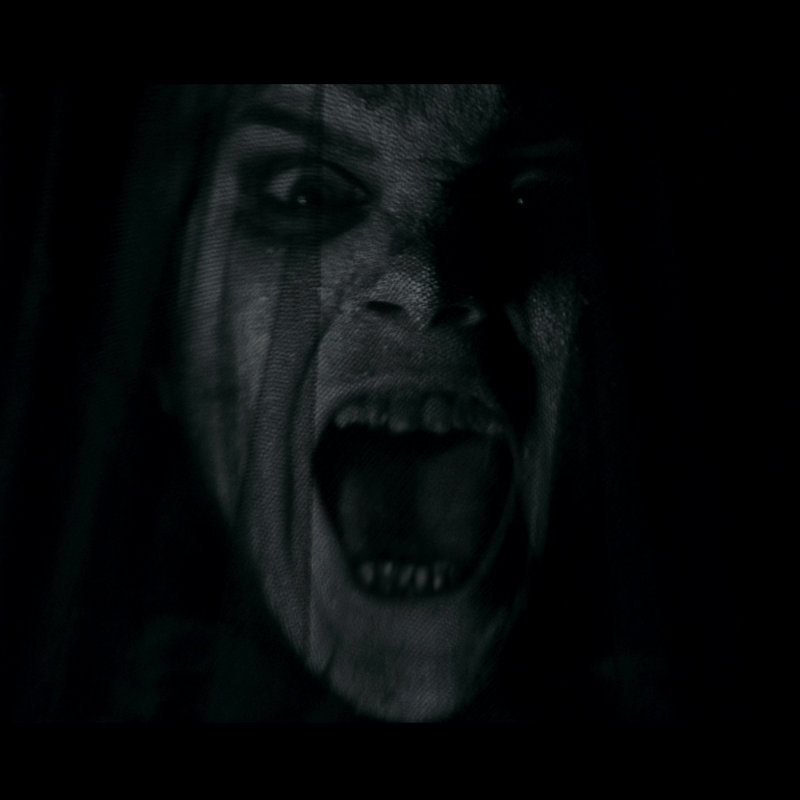 The screenplay was written by Jane Goldman who also penned big budget Hollywood fare such as Kick Ass, the X-Men movies First Class and Days of Future Past as well as genre film The Limehouse Golem. Thankfully Goldman retains the original character names from the book. The film is very different from the book and tv adaption being much darker in tone and full of jump scares. In this version Kipps doesn't attend the funeral of Mrs Drablow and there is no farmers market. Eel Marsh House is a dishevelled ruin more akin to Miss Havishams estate from Great Expectations.
In the book and TV film the woman in black is an omen of death that the villagers of Crythin Gifford have long come to accept. In Hammer's version she is a malignant menace forever lurking on the periphery to snuff out the lives of the local children.
Kipps wife, Stella dies in child birth leaving him with a son, Joseph. Skipping forward four years, the narrative progresses as per the book, Kipps boss orders him to Crythin Gifford, meets Samuel Daily at the end of a long train journey, etc. When Kipps arrives at the Gifford Arms the landlord pretends he can't find Kipps reservation and that the rooms are all fully booked. The landlady intervenes and Kipps is given a room in the attic.
The next day Kipps goes to see Mr Jerome who hands him a parcel of papers and insists Kipps go with Keckwick to the train station and return to London. Kipps instead pays Keckwick to take him to Eel-Marsh House. Kipps sees TWIB in the graveyard, hears the cries of the pony and trap on the causeway and meets Keckwick coming to pick him up.
Upon returning to Crythin Gifford Kipps visits the Police Station and reports the pony and trap accident on the marsh. A child is brought into the police station having drunk lye and subsequently dies. In the evening Kipps goes for supper at Samuel Daily's country pile and meets his wife, Elizabeth. Elizabeth tells Kipps that Nicholas, her dead son, communicates through her and wants to draw him a picture which she scratches into the table with a knife before Samuel Daily sedates her. The image on the table is of a hanged man.
The following day Samuel Daily reluctantly agrees to take Kipps back to Eel Marsh House. The villagers blaming Kipps arrival for the death of the child in the Police station attempt to block their way but Daily manages to drive past them. Daily leaves Kipps and Spider at Eel Marsh House. Reading through the paperwork Kipps learns that Jennet had to give up Nathaniel after being declared mentally unfit. Jennet also dies not from a wasting disease as in the book but by hanging herself in the nursery.
At this point the film goes into overdrive with ghost sightings and jump scares until Samuel Daily arrives to rescue Kipps.
Kipps and Daily arriving back in Crythin Gifford see that the Jerome's basement is on fire. Kipps breaks open the basement door and sees TWIB just before Lucy sets herself on fire.
At the Daily's Mausoleum Elizabeth reveals the curse of TWIB. Elizabeth again becomes posessed by the ghost of Nicholas and scratches a copy of Joseph's picture of himself, Kipps and the train onto the Mausoleum.
Understanding that Joseph's life is now in danger Kipps attempts to cancel Joseph and his Nanny's train journey via telegram only to find the Post Office in Crythin Gifford has burnt down.
Hoping to break the curse of TWIB Kipps and Daily retrieve the corpse of Nathaniel from the marsh and bury him in Jennet's grave.
Kipps and Daily meet Joseph and the nanny at the station. Kipps and Joseph are killed by an oncoming train and are reunited with Stella in the afterlife.